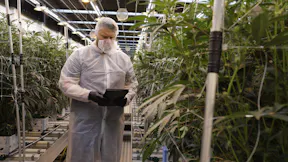
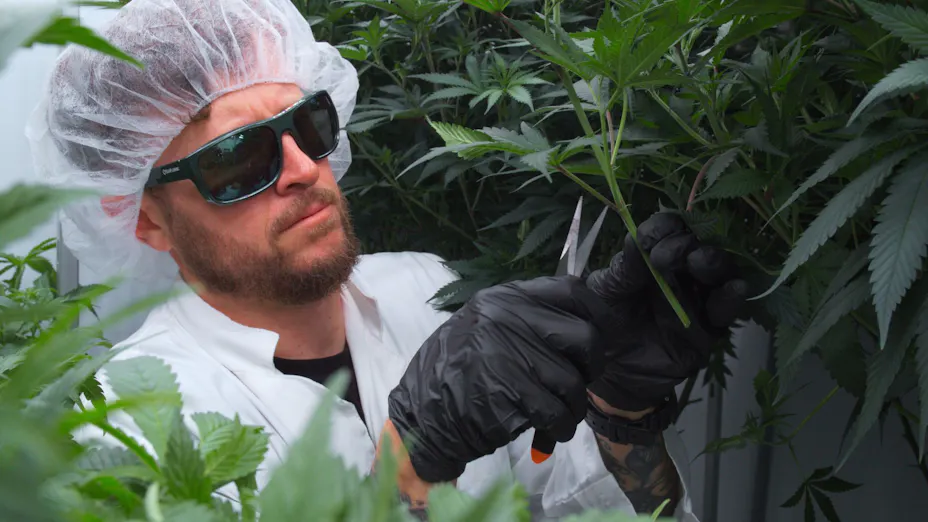
Since joining Grodan as a crop specialist two years ago, Jon Jirikovec has helped many cannabis growers in North America improve their product quality and yields. Having previously worked as a large-scale cannabis grower for more than a decade, he has first-hand experience building efficiency and profitability by reducing labor, increasing production, and optimizing post-harvest processes. Here, he discusses the challenges faced by cannabis growers today and shares his tips for tackling them.
Q1: What are the biggest challenges cannabis growers currently face in North America?
From a business standpoint, the biggest challenge facing commercial growers today is controlling costs while maintaining efficiency and quality. In the U.S., we’re seeing ongoing price compression as markets mature, and wholesale prices continue to fall due to oversupply. As smaller, branded players enter the licensed market, and oversupply continues to push prices down, even large-scale growers are struggling to compete on both price and quality, especially as operational costs keep rising.
Across the board, growers are dealing with increasing operational costs including labor, consumables, and tax burden, which all directly impact efficiency. Missing targets can quickly lead to losses that affect yield, quality, and even brand reputation.
Licensed growers need to increase efficiency and consistently produce acceptable quality and yield to stay competitive and remain profitable. To do this and to keep costs in check, it is imperative to manage resources as efficiently as possible. Operators are focusing on strategies that include data-driven decision making, updating existing facilities to increase operational efficiency, and focusing on product differentiation.
That’s why Grodan continuously runs research trials with leading industry partners around the world to deliver new, science-based insights into how growers can improve yield and quality more efficiently. These trials are tailored to local preferences, regional market dynamics, and country-specific legislation to support growers worldwide in meeting their unique cultivation and production goals.
Q2: According to those latest scientific insights, what’s the key to improving cannabis quality and yield in a scalable way?
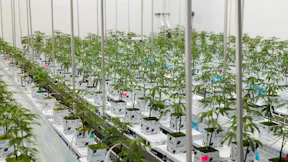
From what we have seen, at scale, quality and yield improve not by pushing extremes, but by controlling variability through consistent climate and root-zone management. Stable conditions help ensure growth isn’t disrupted by stress and allow growers to clearly connect their cultivation methodology to quantifiable results.
Inconsistent climate conditions often lead to inconsistent root zone conditions, which can show up as uneven canopies, varying dry backs from plant to plant, and morphological differences like fox-tailing or excessive internodal spacing. Today’s climate-controlled building management systems make it easier for growers to target a precise balance of climate conditions, including metrics such as VPD, light intensity, and airflow.
When climate conditions are consistently optimized, it allows growers to focus on foundations such as uniform root-zone conditions and consistency. Since Grodan’s stone wool is engineered to repeatable, specific physical and chemical specifications, variability in the root zone is reduced, allowing plants to respond predictably to vegetative and generative steering stimuli.
When it comes to root zone management, key metrics such as electrical conductivity, water content, and overnight dry back are directly influenced by the physical characteristics of the substrate and the surrounding environment. By tracking this data, growers can adjust inputs to align with the plant’s needs throughout each phase of the crop cycle.
Grodan’s balanced approach supports a more uniform crop and a more efficient operation, which becomes increasingly important as operations scale. Data-driven irrigation decisions make strategies repeatable, allowing crops to be grown to the same standard from batch to batch. This reduces variability, maintains quality, and creates predictable harvest outcomes while facilitating labor optimization and resource-use efficiency, ultimately improving profitability and long-term sustainability.
Q3: How does Grodan’s stone wool substrate make it easier for cannabis growers to maintain the necessary consistency?
Grodan’s stone wool is manufactured to defined specifications, meaning every block or slab has the same density, fiber structure and orientation, and water-holding capacity, which reduces variability before the crop is even planted. For growers, these benefits show up immediately in day-to-day operations, with more uniform dry backs across the crop and consistent EC and WC throughout the substrate.
As an inert growing medium, stone wool does not chemically bind or buffer nutrients. As a result, water and nutrients remain freely available in the root zone and respond quickly to changes to irrigation. This gives growers precise control over plant nutrition, and because stone wool responds rapidly to water and fertilizer adjustments, it allows irrigation strategies to be adjusted quickly and efficiently. Through effective nutrient refreshment, Grodan’s Improved stone wool supports better EC control with less drain, especially during generative steering, while the advanced wetting agent ensures uniform WC and EC distribution throughout the substrate.
Another important benefit is starting each crop with a truly “clean slate.” No pests or pathogens enter the facility through a Grodan substrate, which is a major biosecurity advantage from an integrated pest and disease management standpoint. Also, growers can significantly improve labor efficiency through fewer plant touches, faster harvest times, and improved ergonomics. Growers spend less time cleaning floors, benches, drains, and irrigation systems between cycles since there are no tannins or organic material leached from the substrate. And, in an industry where labor remains one of the largest cultivation costs, these efficiencies can have a meaningful impact on overall operational performance.
Q4: What about Grodan’s data solutions? How do they contribute to more consistency across cannabis crop cycles?
The GroSens Suite combines root-zone sensors that measure water content, electrical conductivity, and temperature with climate sensors that track relative humidity, CO₂ concentration, ambient temperature, and vapor pressure deficit. Together, this data allows growers to make informed, data-driven decisions about what inputs their plants need. Grodan’s root-zone sensors are developed and optimized specifically for each Grodan substrate configuration, which means the data is more accurate and representative than what growers would get from generic sensors.
Growers have access to this data on their computer or smartphone, providing real-time visibility into what’s happening with the crop. Alarm functions are especially useful when managing a crop cycle. When I was operating, I treated them as a form of crop insurance because they allowed me to catch issues before they became costly problems.
At one facility, we had a flower room running overnight due to power limitations. Around 3:00 a.m., I received an alarm notification indicating that the room had reached low water content. The batch tank pump had failed, and the room was no longer receiving irrigation events.
Without that alarm, the issue would not have been discovered until staff arrived the following morning, leading to a significant crop loss. Because the system flagged the problem immediately, I was able to respond, restore irrigation, and prevent major damage. In that case, a single alarm helped save a crop valued at roughly half a million dollars.
So, for growers focused on protecting their investment and avoiding preventable losses, the GroSens Suite is an essential tool.
Q5: How have you helped real-world cannabis growers to improve yields in practice?
A great example of this was when I introduced Grodan’s five-phase model to a well-established cultivation company operating multiple facilities across California. The cultivation team was already achieving impressively high yields, but we were able to take performance even further by applying a more structured and targeted irrigation strategy in the flower phase of the crop cycle.
With a few small adjustments to how the plants were being managed through the root zone, steering slightly more generatively at the right moments in the cycle, fine-tuning shot sizes, and paying closer attention to dry-back targets, the team saw a measurable increase in yield and quality. That improvement translated directly into higher annual revenue and increased overall profitability for the company. Just as importantly, it gave the cultivation team a clear win they could measure, see in the crop, and feel proud of.
In another case, a company in Michigan saw positive results by switching from coco coir to Grodan’s stone wool. This change significantly reduced the incidence of failed harvest COAs due to Aspergillus spp. Michigan is known for having some of the strictest microbial and safety testing requirements in the country, and because Grodan’s stone wool provides a clean start, a higher percentage of each harvest is now passing state-required quality and safety assurance testing. As a result, the company has strengthened both its financial performance and its brand reputation.
Q6: What’s your top tip for cannabis growers who are looking to improve their yields without compromising on quality?
First, start with accessing data. Implement a climate and root-zone monitoring system, so decisions are based on what’s actually happening in the room, not assumptions. Once that foundation is in place, start by addressing any low-hanging fruit, things like inconsistent climate between rooms, or irrigation variability that leads to non-uniform dry backs and unstable EC. These issues are often easy to spot when you have data, and correcting them can have an immediate impact on crop uniformity and performance.
Lastly, don’t try to solve everything alone. Share your challenges with us so you can tap into our experience, grower network, and technical resources. Whether that’s validating a new strategy or running a stone wool trial, seeing these improvements firsthand makes it much easier to translate consistency and control into results.